
How the AI Longevity Assistant Works — And Why It's Not Just Another Health Chatbot
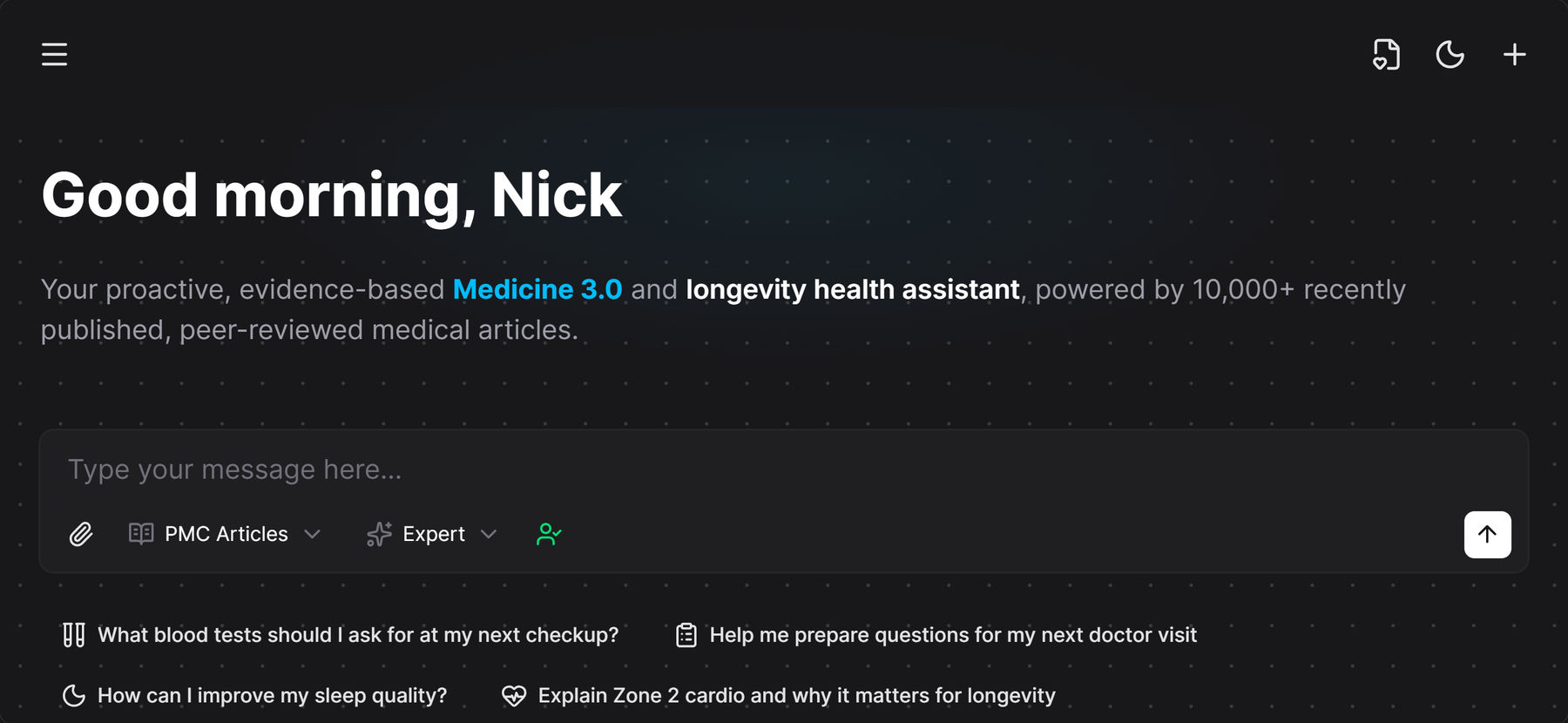
Your evidence-informed health education companion.
If you've spent any time optimizing your health — tracking biomarkers, reviewing studies, preparing questions for your doctor — you've probably tried asking an AI for help. And you've probably been disappointed. Generic chatbots pull from the open web, can't distinguish a randomized controlled trial from a supplement company's blog, and treat every user the same regardless of their health profile. We built the AI Longevity Assistant to solve that problem.
The Core Problem: Signal vs. Noise
The difficulty with using AI for health research isn't that the models lack capability — it's that they lack constraints. When you ask ChatGPT or Claude about ApoB targets, the model draws from its entire training corpus: clinical guidelines, Reddit threads, affiliate marketing pages, and outdated textbook content, with no way for you to know which source informed the answer.
This matters because health decisions are downstream of information quality. A 2023 study in JAMA Internal Medicine found that evaluators preferred AI-generated responses over physician responses in 78.6% of cases — but only when the AI had access to high-quality source material (Ayers et al., 2023). The model is only as good as what it reads.
The AI Longevity Assistant addresses this by constraining the AI's knowledge base to a curated, auditable set of peer-reviewed literature — and by giving it structured context about you.
What's Under the Hood
A Curated Medical Knowledge Base
The assistant is grounded in 21,000+ articles from PubMed Central's Open Access subset — the same literature database used by clinicians and researchers worldwide. This isn't a web scrape. Every article in the corpus meets strict criteria:
- Evidence hierarchy: Systematic reviews, meta-analyses, randomized controlled trials, clinical practice guidelines, and Mendelian randomization studies. Lower-quality evidence types are excluded at ingestion time.
- Journal quality: JAMA, The Lancet, NEJM, BMJ, ACSM, NSCA, and comparable publications.
- Recency: Published between 2019 and 2026. The corpus is periodically refreshed to incorporate new research.
- Topic coverage: 22 categories aligned with Medicine 3.0 principles — covering the "Four Horsemen" (metabolic disease, cardiovascular disease, cancer, neurodegenerative decline) plus exercise physiology, sleep architecture, nutrition science, and more.
- Licensing: Only CC0, CC BY, and CC BY-SA articles are included, ensuring commercial-safe usage.
Articles are seeded with NCBI relevance ranking for PubMed Central queries. PubMed's documented Best Match system uses BM25 first-stage ranking plus LambdaMART machine-learning re-ranking over 150+ relevance signals; we use the PMC sort=relevance result as a practical relevance heuristic for corpus curation, not as a substitute for a systematic literature search. The selected articles are then embedded using Gemini's latest embedding model for retrieval. When you ask a question, the AI searches this corpus, retrieves the most relevant passages, and generates a response grounded in those sources — with clickable citation badges linking directly to each article on PubMed Central.
A Health Profile That Shapes Every Response
Most health AIs ask for your chronological age, then proceed to give the same generic advice. They can't calculate your real biological age (our Real Age Calculator does this by analyzing movement and posture) or answer visual questions like "how old do I look?" using AI facial analysis. The AI Longevity Assistant takes a different approach: a structured 6-section health intake with 40+ fields that directly influence how the AI interprets your questions and frames its responses.
The sections:
- Essentials — age, biological sex, height, weight, exercise frequency, primary health goals
- Lifestyle — diet quality score (which you can optimize using our High Protein Foods Database or Optimal Protein Intake Calculator), sleep duration, stress level, smoking status, alcohol intake, available equipment
- Medical History — diagnosed conditions, family history, current medications
- Fitness Metrics — VO₂ max (estimated via our Fitness Age Calculator), grip strength (a key predictor of physiological decline in our Centenarian Decathlon Calculator), DEXA body composition (which shapes your metabolic rate in our Muscle Maker Calculator)
- Biomarkers — ApoB (a critical metric for preventing heart disease), Lp(a), fasting insulin, HOMA-IR, hs-CRP, HbA1c, triglycerides
- Wearable Data — resting heart rate, HRV, sleep architecture
When your profile is active, the AI references longevity-optimal thresholds — not just standard clinical ranges. For example, if your ApoB is 110 mg/dL, the assistant doesn't just tell you it's "within normal limits." It contextualizes that number against the thresholds that forward-thinking Medicine 3.0 physicians target (typically < 60–80 mg/dL, depending on risk stratification).
Your profile is stored in your secure account, never used for advertising, and can be toggled on or off per conversation.
Proactive Nudging — Surfacing What You Don't Know to Ask
This is the feature that most distinguishes the assistant from a reactive Q&A tool.
After each health-related response, the AI analyzes your health profile and identifies the single highest-impact, lowest-effort optimization you haven't asked about. It surfaces this as an inline recommendation with three components:
- A specific effort estimate (e.g., "45 minutes per week" or "$50 one-time test")
- A quantified expected outcome (e.g., "VO₂ max ↑ 10–15% in 12 weeks")
- A friction-reduction note addressing the most common barrier (e.g., "You can do this on a stationary bike while watching TV")
The nudge engine evaluates 7 categories in priority order:
| Priority | Category | Example Trigger |
|---|---|---|
| 1 | Missing exercise modality | Strength training only, no cardio |
| 2 | Training frequency gap | < 6 days/week of activity |
| 3 | Equipment ROI | No cardio equipment → stationary bike suggestion |
| 4 | Sleep optimization | < 7 hours/night |
| 5 | Biomarker gaps | No ApoB, VO₂ max, or Lp(a) on file |
| 6 | Screening gaps | Age/sex/family history → overdue screenings |
| 7 | Nutrition quick wins | Diet quality score < 6 |
The system includes fatigue guardrails — one nudge per response maximum, no repeats within a conversation, and no forced nudges on purely informational queries.
Doctor Visit Prep
One of the most practical features: the assistant can generate a structured, printable summary of your conversation — organized by topics to discuss, biomarkers to review (using our guide to affordable at-home tests), and lifestyle changes to validate with your clinician.
If you've ever walked out of a 15-minute appointment realizing you forgot to ask about half your list, this is the feature that closes that gap. It turns your late-night research into a document your doctor can actually use.
YouTube Video Analysis
Paste a YouTube URL into the chat and the assistant will analyze the video content natively — no external transcription service required. It generates a structured summary with timestamps, key takeaways, and cross-references claims against the PMC knowledge base.
This is particularly useful for evaluating longevity-focused podcast episodes, where claims can range from well-supported to speculative. The assistant adds a Medicine 3.0 perspective so you can separate evidence from opinion.
Exercise Video Recommendations
When the AI generates a workout framework, it doesn't just name exercises. It searches for demonstration videos from credentialed professionals — licensed physical therapists and CSCS-certified coaches — and renders them inline with thumbnails, channel attribution, and duration.
Architecture Comparison
For those who want to understand what's actually different at a systems level:
| Dimension | AI Longevity Assistant | General-purpose AI (ChatGPT, Claude) | Typical health chatbots |
|---|---|---|---|
| Knowledge source | 21,000+ curated PMC OA articles | Entire web (unfiltered training data) | Varies; often SEO-optimized content |
| Evidence filtering | Systematic reviews, meta-analyses, RCTs, guidelines only | None | None |
| Source attribution | Clickable PMC citation badges with article title, journal, year | Inline text (often unverifiable) | Rarely cited |
| Personalization depth | 6-section, 40+ fields, biomarker-aware | Manual context window management | Basic demographics |
| Threshold framework | Longevity-optimal (Medicine 3.0) | Standard clinical ranges | Standard clinical ranges |
| Proactive analysis | 7-category nudge engine | Reactive only | Reactive only |
| Visit prep output | Structured, printable summary | Not available | Not available |
| Video analysis | Native YouTube processing | Text only | Not available |
| Grounding toggle | PMC literature or Google Search | Web only | Web only |
| Data retention | Auto-expiring (7d anonymous / 90d authenticated) | Used for model training (varies) | Varies |
| Cost | Free tier available | $20+/month | Varies |
Privacy and Data Handling
Health data requires a higher standard. The AI Longevity Assistant implements:
- No advertising or data sales. Your conversations and health profile are never monetized.
- Auto-expiring data. Anonymous sessions: 7-day TTL. Authenticated sessions: 90-day TTL. Pinned chats are retained until you unpin or delete them.
- No model training on your data. Conversations are not used to train or fine-tune AI models.
- Infrastructure: Firebase Authentication, Firestore with encryption at rest, HTTPS/TLS in transit, Firebase App Check (reCAPTCHA Enterprise) on all endpoints, server-side rate limiting.
Full details are available in our Privacy Policy.
Medicine 3.0 Alignment
The assistant isn't a generic chatbot with a health-themed wrapper. It's built around the Medicine 3.0 framework — the proactive, prevention-focused approach to healthcare that prioritizes:
- Early intervention over reactive treatment
- Personalized risk stratification over population averages
- The Four Horsemen — metabolic disease, ASCVD, cancer, and neurodegenerative decline — as the primary optimization targets
- Continuous monitoring — treating healthspan as an ongoing engineering problem, not a series of annual checkups
If you're looking for a physician who shares this philosophy, our Medicine 3.0 doctors directory can help you find one.
Get Started
The AI Longevity Assistant is available now with a free account. Creating an account unlocks:
- 21,000+ peer-reviewed PMC studies as the AI's knowledge base
- YouTube fact-checking — verify health claims against the literature
- 6-section health profile — personalized to your biomarkers and fitness metrics
- Proactive insights — the optimizations you haven't thought to ask about
- Doctor visit prep — printable conversation summaries for your clinician
- Exercise demonstrations — from credentialed professionals
- Current AI models — automatically upgraded as better models become available
No credit card required.
Disclaimer
The AI Longevity Assistant is an educational tool and does not constitute medical advice, diagnosis, or treatment. It is designed to help you research health topics, understand peer-reviewed evidence, and prepare better questions for a licensed healthcare provider. Always consult a qualified clinician before making health decisions based on any information provided.
References
- Ayers, J. W., Poliak, A., Dredze, M., et al. (2023). Comparing Physician and Artificial Intelligence Chatbot Responses to Patient Questions Posted to a Public Social Media Forum. JAMA Internal Medicine, 183(6), 589–596.
- Brodeur, P. G., Buckley, T. A., Kanjee, Z., et al. (2024). Superhuman performance of a large language model on the reasoning tasks of a physician. arXiv:2412.10849.
- López-Otín, C., Blasco, M. A., Partridge, L., Serrano, M., & Kroemer, G. (2023). Hallmarks of aging: An expanding universe. Cell, 186(2), 243–278.